Tuesday, April 2, 2019

Tech Book Face Off: Rails AntiPatterns Vs. The Rails 5 Way

It's been a while since I've cracked open a Ruby on Rails book, and there were still a couple of these books that I've been meaning to read. So far the Rails books I've read have been beginner's books and tutorials. With this latest pair of books, I wanted to go deeper into Rails and learn how to program fluently in the framework. The first book, Rails AntiPatterns: Best Practice Ruby on Rails Refactoring by Chad Pytel and Tammer Saleh, was published way back in 2010 when Rails 2.3 was cutting edge. I took a chance that the book would focus more on timeless advice than version-specific tips and tricks. The opposing book, The Rails 5 Way by Obie Fernandez, was published much more recently at the end of 2017 and should be at less risk of being out-of-date. Although, it looks like Rails 6 will be out soon. One thing's for sure: technology doesn't stand still, but that shouldn't matter too much if the books take that into account. Let's see how they fare.
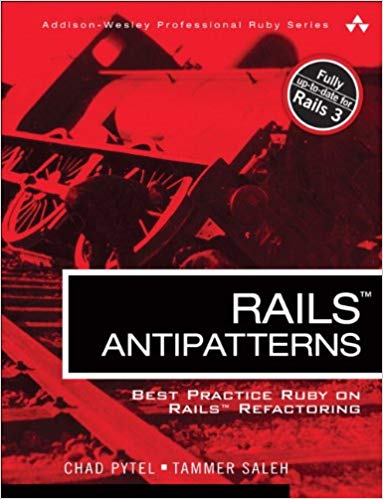
Rails AntiPatterns front coverVS.The Rails 5 Way front cover

Rails AntiPatterns


Most programming books will tell you the right way to do things and give examples of how to implement that advice. This book takes a different tack and instead shows you what not to do, with examples of how to refactor those mistakes into clean Rails code. This change in approach is refreshing for the intermediate to advanced programmer because over time we develop certain habits as we try to discover how to do things in a language or a framework, and they're not always the best (or even very good) ways of doing those things. Having a book to help identify where our code has gone astray and how to fix it is a helpful tool indeed.

I was a bit worried about reading a book specifically about Rails that was written so many versions ago, being that Rails 2.3 was out at the time and we're now heading into Rails 6.0. I normally don't mind reading older books about programming in general, since those books have been filtered by time and tend to contain plenty of wisdom that has survived current fads. However, this is a book about a specific web framework, so if it is over eight years old, how could it possibly still be relevant? I needn't have worried. Most of the book focuses on general good programming practices within the context of the Rails environment. Such advice is still as valid in Rails 6.0 as it was in Rails 2.3, even if some of the implementation details have changed.

The structure of the book works well, with ten chapters each focusing on a different topic of the Rails framework. These topics range from the obvious models, views, and controllers on which the Rails architecture is based, to the related services, testing, and databases that are all a part of web application programming. Each topic covers a few antipatterns with descriptions of a common programming mistake and why it's wrong, followed by one or more solutions that fix up the antipattern into beautiful, DRY code. The obvious solutions—like that views should contain strictly display logic, controllers should be thin, and models should contain all of the business logic, but broken out into helpers and plain Ruby objects—are covered along with a number of less obvious antipatterns. Some of the more extended solutions are quite satisfying to follow as the refactorings morph an ugly hack into a pretty Rails implementation.

Throughout these refactored antipatterns the authors relate clear reasons for why things should be done a certain way and sound advice on how to choose between competing options. For example, when discussing whether or not to use scopes to create chainable filters on models, they say:
There are downsides to this approach, including problems with readability and simplicity, as well as abuse of the Law of Demeter. Whether you use this approach is a judgment call on your part. Will you use the added flexibility? Is it better than defining a handful of separate finders? Like many advanced refactorings, this one has no easy answer and depends greatly on your tastes.
I appreciate the honesty of this advice. In programming, as in most things in life, not all rules are hard and fast. Multiple good options can and do exist, and in these cases it comes down to a judgement call from the programmer, given the context of the specific situation. Experience and taste will develop into a programmer's style, and as long as they're not making a poor choice for the wrong reason, it's okay to prefer one viable option over another.

The authors aren't always so amenable to choice in correcting antipatterns. They do discourage attempts at divining the future, as in this example:
Developers new to the template pattern tend to want to err on the side of flexibility. This is a form of future-proofing, and it's a mistake—especially when working in a language as geared toward agile development and the refactoring cycle as Ruby.
It's almost always better to spend time fixing real problems in the here and now instead of trying to predict and head off future problems that may never happen.

The whole book was full of insights like these, and it was all packaged in easy-to-read prose and concise, relevant examples of how not to write Rails code, followed by how to fix it. I found it to be a quite enjoyable way to learn better Rails programming practices, and it reminded me of an old chess book that had followed a similar format: How Not to Play Chess. Seeing the mistakes that can be made and their consequences clearly laid out can prove quite helpful in identifying our own mistakes and seeing the path to correcting them. This teaching method was expertly executed in Rails AntiPatterns, and I highly recommend giving it a read if you do any programming in Rails.

The Rails 5 Way


This was definitely the longest book on a programming language or framework that I've read in a while. Weighing in at over a thousand pages, it definitely achieves tome status, and strives to be a comprehensive map of the Rails 5 framework. The forwards and introduction recommend reading it straight through at least once to get the lay of the land and see everything that's available in Rails before using it as a reference.

I would agree that knowing what tools are available in any given language or framework is half the battle when attempting to develop solutions as efficiently as possible. If you know that something you want to do is possible and you know where to look to research how to do it, then you're already ahead of the game in reaching an optimal solution. However, I was not going to read all the way through this book, considering the last third of it is a pure reference listing of the Active Model and Active Support APIs. That's skim-worthy material at best.

At least another third of the non-appendix part of the book is also reference listings of various APIs in the Rails framework. The trouble with this reference material is that it is interspersed with actual guidance on how to use the different parts of Rails. That makes it much harder to skim through the boring, tedious method descriptions without missing tidbits of more useful information, so most of the book was kind of a slog.

Obie Fernandez took a slightly unconventional approach to covering Rails, and instead of starting with Active Record, he started at a high level by covering the Rails configuration and environments, then followed the flow of a request by going into routes, REST, resources, and controllers before getting to Active Record. After five chapters of the various aspects of Active Record, he continued with Action View, helpers, and Haml, followed up by an assortment of short chapters on session management, security, Action Mailer, caching, background processing, Ajax, Turbolinks, Action Cable, and testing with RSpec. Whew. Like I said, comprehensive, and even if some things couldn't be included in depth, they were at least mentioned so that the reader could be aware of them and do more research on their own.

Some chapters were quite useful and informative, like the main chapters on the MVC architecture of Rails. These chapters contained a fair amount of good advice and recommendations that can save developers a lot of trouble, such as:
Rails' schema definition provides the authoritative record of truth for the latest version of your database schema. If you need to recreate your database on another server, you should be using db:schema:load, not running all the migrations from scratch.
Anyone who's tried to run a long chain of migrations while setting up an application on a new machine can attest to the futile debugging situation you end up in when one of the migrations inevitably fails halfway through. Using the schema is definitely the way to go. I also found the chapters on security, caching, and Turbolinks to be quite helpful, and I learned a bunch of great things that will help me build better Rails applications.

On the other hand, there were large swaths of the book that were pure drudgery. Most of the helpers chapter was like this with page after page of very similar method descriptions:
11.3.1 asset_path(source, options = {})
Computes the path to asset in public directory. If :type options is set, a file extension will be appended and scoped to the corresponding public directory. All other asset *_path helpers delegate through this method.

<...code example...>

11.3.2 asset_url(source, options = {})
Computes the full URL to an asset in the public directory. This will use asset_path internally, so they behave the same way. If the :host option is set, it overrides the global config.action_controller.asset_host setting normally set in config/environments/production.rb.

asset_url "application.js", host: "http://cdn.example.com" # => http://cdn.example.com/assets/application.js

Also aliased as url_to_asset.
Ugh. This kind of stuff is much easier to search for in the online Rails documentation when you need to look it up, not by paging through a giant book. I was also surprised at how much of these method descriptions ended with comments about how useless they were. Maybe 20% of the methods would have a description of what they did with a code example, and then Fernandez would end it with saying he had never found a use for this method or you would never want to do things this way because some other method was much better. That got more than a little frustrating as the book dragged on.

It may sound a bit strange to criticize this book for including ways not to do things in Rails, having just praised a book whose entire structure was showing how not to do things and then showing the right way, but this is different. In Rails AntiPatterns, the author was showing common mistakes when programming in Rails and how to fix those mistakes by using Rails the right way. My complaint with The Rails 5 Way is that time is spent describing irrelevant methods that may have been included in the framework for completeness or for a specific, uncommon use case, but are hardly ever used in practice. When those things are included in a book whose title asserts that this is how things should be done, it muddies the waters.

Between the appendices, the long lists of method descriptions, and the inclusion of dozens of methods that are rarely used, this book is probably three to four times longer than it needs to be, all for the sake of being comprehensive. It was light enough on actual recommendations for how to use Rails, focusing more on every single thing that's available, that a more appropriate title would simple be The Rails 5 Documentation.


I much prefer reading programming books that directly address the 'how' and 'why' of programming, like these books I previously reviewed on how to use Rails. The Ruby on Rails Tutorial is especially good and the latest version is also up-to-date with Rails 5.  Even Rails AntiPatterns is still relevant nearly a decade later because it addresses the fundamentals of developing in Rails. I would rather leave the 'what' of programming to the online documentation where it is easily searchable and stays updated to the latest version of the tools. In that respect The Rails 5 Way falls flat. It would have been a much more compelling book if it had stripped out all of the drab documentation and focused on showing the right way to program in Rails and explaining why that was the best way to do it. As it is, reading through Rails AntiPatterns and referring to the online documentation is the more productive path.

Monday, April 1, 2019

SuperTux 0.4.0 Milestone 2

Over ten years after the last stable release of SuperTux (0.1.3 released July 2005) the SuperTux team have announced the release of the first stable version in the Milestone 2 series.

Compared to 0.1.3, this release features:
  • a nearly completely rewritten game engine based on OpenGL, OpenAL, SDL2, ...
  • support for translations
  • in-game manager for downloadable add-ons and translations
  • Bonus Island III, a for now unfinished Forest Island and the development levels in Incubator Island
  • a final boss in Icy Island
  • new and improved soundtracks and sound effects
  • new badguys, bonuses and power-ups (air-, earth- and ice-flower)
  • a halloween tilemap
  • new graphic effects (glowing objects, particles, ...)
  • levels and worldmaps are scriptable using squirrel
  • much more game objects: trampolines, switches, portable stones, wind, moving platforms, ... - most of them have scripting APIs
  • improved statistics
  • many invisible changes, like unit tests, efficiency improvements and more bugfixes
  • much more...
And of course we updated the official levels to make use of all the new features.

SuperTux 0.4.0 Overworld
It has been a long road for the project, and a lot has changed as the engine seems to have been largely rewritten to make it suitable for more advanced graphics and scripting. Whilst the existing content has been updated, it would seem that the one area in which the project is short is new tilesets and levels, with only a partially complete 2nd forest overworld of the (originally planned) 7 desired worlds.

That's where the community comes in though. With a stable game to work with, hopefully players and artists can combine to extend the game and make it enjoyable for generations to come.

My own 15 year old son remembers SuperTux 0.1.3 fondly as, he says, the best game he played as a young child.

Friday, March 29, 2019

13 Best Highest Paying URL Shortener Sites to Earn Money Online 2019

  1. Linkbucks

    Linkbucks is another best and one of the most popular sites for shortening URLs and earning money. It boasts of high Google Page Rank as well as very high Alexa rankings. Linkbucks is paying $0.5 to $7 per 1000 views, and it depends on country to country.
    The minimum payout is $10, and payment method is PayPal. It also provides the opportunity of referral earnings wherein you can earn 20% commission for a lifetime. Linkbucks runs advertising programs as well.
    • The payout for 1000 views-$3-9
    • Minimum payout-$10
    • Referral commission-20%
    • Payment options-PayPal,Payza,and Payoneer
    • Payment-on the daily basis

  2. Short.pe

    Short.pe is one of the most trusted sites from our top 30 highest paying URL shorteners.It pays on time.intrusting thing is that same visitor can click on your shorten link multiple times.You can earn by sign up and shorten your long URL.You just have to paste that URL to somewhere.
    You can paste it into your website, blog, or social media networking sites.They offer $5 for every 1000 views.You can also earn 20% referral commission from this site.Their minimum payout amount is only $1.You can withdraw from Paypal, Payza, and Payoneer.
    • The payout for 1000 views-$5
    • Minimum payout-$1
    • Referral commission-20% for lifetime
    • Payment methods-Paypal, Payza, and Payoneer
    • Payment time-on daily basis

  3. Cut-win

    Cut-win is a new URL shortener website.It is paying at the time and you can trust it.You just have to sign up for an account and then you can shorten your URL and put that URL anywhere.You can paste it into your site, blog or even social media networking sites.It pays high CPM rate.
    You can earn $10 for 1000 views.You can earn 22% commission through the referral system.The most important thing is that you can withdraw your amount when it reaches $1.
    • The payout for 1000 views-$10
    • Minimum payout-$1
    • Referral commission-22%
    • Payment methods-PayPal, Payza, Bitcoin, Skrill, Western Union and Moneygram etc.
    • Payment time-daily

  4. Adf.ly

    Adf.ly is the oldest and one of the most trusted URL Shortener Service for making money by shrinking your links. Adf.ly provides you an opportunity to earn up to $5 per 1000 views. However, the earnings depend upon the demographics of users who go on to click the shortened link by Adf.ly.
    It offers a very comprehensive reporting system for tracking the performance of your each shortened URL. The minimum payout is kept low, and it is $5. It pays on 10th of every month. You can receive your earnings via PayPal, Payza, or AlertPay. Adf.ly also runs a referral program wherein you can earn a flat 20% commission for each referral for a lifetime.
  5. Ouo.io

    Ouo.io is one of the fastest growing URL Shortener Service. Its pretty domain name is helpful in generating more clicks than other URL Shortener Services, and so you get a good opportunity for earning more money out of your shortened link. Ouo.io comes with several advanced features as well as customization options.
    With Ouo.io you can earn up to $8 per 1000 views. It also counts multiple views from same IP or person. With Ouo.io is becomes easy to earn money using its URL Shortener Service. The minimum payout is $5. Your earnings are automatically credited to your PayPal or Payoneer account on 1st or 15th of the month.
    • Payout for every 1000 views-$5
    • Minimum payout-$5
    • Referral commission-20%
    • Payout time-1st and 15th date of the month
    • Payout options-PayPal and Payza

  6. BIT-URL

    It is a new URL shortener website.Its CPM rate is good.You can sign up for free and shorten your URL and that shortener URL can be paste on your websites, blogs or social media networking sites.bit-url.com pays $8.10 for 1000 views.
    You can withdraw your amount when it reaches $3.bit-url.com offers 20% commission for your referral link.Payment methods are PayPal, Payza, Payeer, and Flexy etc.
    • The payout for 1000 views-$8.10
    • Minimum payout-$3
    • Referral commission-20%
    • Payment methods- Paypal, Payza, and Payeer
    • Payment time-daily

  7. Short.am

    Short.am provides a big opportunity for earning money by shortening links. It is a rapidly growing URL Shortening Service. You simply need to sign up and start shrinking links. You can share the shortened links across the web, on your webpage, Twitter, Facebook, and more. Short.am provides detailed statistics and easy-to-use API.
    It even provides add-ons and plugins so that you can monetize your WordPress site. The minimum payout is $5 before you will be paid. It pays users via PayPal or Payoneer. It has the best market payout rates, offering unparalleled revenue. Short.am also run a referral program wherein you can earn 20% extra commission for life.
  8. Shrinkearn.com

    Shrinkearn.com is one of the best and most trusted sites from our 30 highest paying URL shortener list.It is also one of the old URL shortener sites.You just have to sign up in the shrinkearn.com website. Then you can shorten your URL and can put that URL to your website, blog or any other social networking sites.
    Whenever any visitor will click your shortener URL link you will get some amount for that click.The payout rates from Shrinkearn.com is very high.You can earn $20 for 1000 views.Visitor has to stay only for 5 seconds on the publisher site and then can click on skip button to go to the requesting site.
    • The payout for 1000 views- up to $20
    • Minimum payout-$1
    • Referral commission-25%
    • Payment methods-PayPal
    • Payment date-10th day of every month

  9. Wi.cr

    Wi.cr is also one of the 30 highest paying URL sites.You can earn through shortening links.When someone will click on your link.You will be paid.They offer $7 for 1000 views.Minimum payout is $5.
    You can earn through its referral program.When someone will open the account through your link you will get 10% commission.Payment option is PayPal.
    • Payout for 1000 views-$7
    • Minimum payout-$5
    • Referral commission-10%
    • Payout method-Paypal
    • Payout time-daily

  10. Clk.sh

    Clk.sh is a newly launched trusted link shortener network, it is a sister site of shrinkearn.com. I like ClkSh because it accepts multiple views from same visitors. If any one searching for Top and best url shortener service then i recommend this url shortener to our users. Clk.sh accepts advertisers and publishers from all over the world. It offers an opportunity to all its publishers to earn money and advertisers will get their targeted audience for cheapest rate. While writing ClkSh was offering up to $8 per 1000 visits and its minimum cpm rate is $1.4. Like Shrinkearn, Shorte.st url shorteners Clk.sh also offers some best features to all its users, including Good customer support, multiple views counting, decent cpm rates, good referral rate, multiple tools, quick payments etc. ClkSh offers 30% referral commission to its publishers. It uses 6 payment methods to all its users.
    • Payout for 1000 Views: Upto $8
    • Minimum Withdrawal: $5
    • Referral Commission: 30%
    • Payment Methods: PayPal, Payza, Skrill etc.
    • Payment Time: Daily

  11. CPMlink

    CPMlink is one of the most legit URL shortener sites.You can sign up for free.It works like other shortener sites.You just have to shorten your link and paste that link into the internet.When someone will click on your link.
    You will get some amount of that click.It pays around $5 for every 1000 views.They offer 10% commission as the referral program.You can withdraw your amount when it reaches $5.The payment is then sent to your PayPal, Payza or Skrill account daily after requesting it.
    • The payout for 1000 views-$5
    • Minimum payout-$5
    • Referral commission-10%
    • Payment methods-Paypal, Payza, and Skrill
    • Payment time-daily

  12. Linkrex.net

    Linkrex.net is one of the new URL shortener sites.You can trust it.It is paying and is a legit site.It offers high CPM rate.You can earn money by sing up to linkrex and shorten your URL link and paste it anywhere.You can paste it in your website or blog.You can paste it into social media networking sites like facebook, twitter or google plus etc.
    You will be paid whenever anyone will click on that shorten a link.You can earn more than $15 for 1000 views.You can withdraw your amount when it reaches $5.Another way of earning from this site is to refer other people.You can earn 25% as a referral commission.
    • The payout for 1000 views-$14
    • Minimum payout-$5
    • Referral commission-25%
    • Payment Options-Paypal,Bitcoin,Skrill and Paytm,etc
    • Payment time-daily

  13. LINK.TL

    LINK.TL is one of the best and highest URL shortener website.It pays up to $16 for every 1000 views.You just have to sign up for free.You can earn by shortening your long URL into short and you can paste that URL into your website, blogs or social media networking sites, like facebook, twitter, and google plus etc.
    One of the best thing about this site is its referral system.They offer 10% referral commission.You can withdraw your amount when it reaches $5.
    • Payout for 1000 views-$16
    • Minimum payout-$5
    • Referral commission-10%
    • Payout methods-Paypal, Payza, and Skrill
    • Payment time-daily basis

Download Ghost Rider Mod For Gta Sandeas

                                                          y.yadav gamer

                      mod for gta sandeas only


                             all types hack repack


                           see our my tube


mod is made for only gta sandeas not for any gta and other self plese dont use this mod for any other gta sandeas hardly reqested for all viwer to read how  to use this go to discrition of mod(dom)

note  dont use any mod usin this mod please  

                                                                         dom

to activate this mod press home button
to control your bike press control+c
to fire the mod press+x
to atack any one press+tab+r
to give fire well press+t


                                                  mod password is+fulla1 


click here to download click
click here to download in full speed click 


         installigation  video will  soon avlable


The Battle Of Lonely Hill

There's no better way to come up with a solution for a nagging problem than to stop thinking about it.

The NorthWest Mounted Rifles had galloped forward to seize the hill (seebut were driven off by the Zouaves. The swift arrival of reinforcements allowed the Queen's forces to drive off the Zouaves in turn.
In this case my original intention was just to tweak my Square Brigadier rules so I could use more figures and play longer games without them dragging. However, lurking below the surface was that suppressed urge for something more like playing with toy soldiers and less like a board game even if that board game worked well and was fun.

Both sides rushed reinforcements to the front. An indecisive long range firefight followed while the armies extended their lines and prepared for a decisive attack.
What I ended doing, step by step without seeing where I was headed was creating exactly what I had wanted, a fairly conventional toy soldier game with units of individual figures (even if fixed to bases for convenience) but using a grid for measuring.
The Queen's forces won the build up race. (1 die each turn for 4,5,6 to bring on a new unit.

The key decisions were to use larger units on smaller squares and to allow units to spread across multiple contiguous squares, measuring movement, ranges and arcs of fire  separately by 3" square. (Invisible or nominal squares at the moment but soon to be marked.)

The Rebels have no option but to strike before the odds get worse or give it up. A fierce and prolonged close quarters fight resulted but the attack was eventually thrown back.
The result was so much like a simplified MacDuff game that I borrowed the morale and charge resolution and various other rules from MacDuff as well.

An attempt to rally was broken up by rifle and artillery fire and with all of the Rebel Brigadiers wounded, the Rebel army suddenly collapsed.
The result was exactly what I have been looking for. Now to bring my 6 and 8 figure infantry units up to 12, do some dismounted cavalry, get some limbers painted up  and......

The Defended Frontier (click on link to read the short, 4 page, version of the rules.)

Report To Stakeholders 2018


This is my fourth report to stakeholders of Black Diamond Games, Ltd. We're a private company with a lot of transparency. I'm going to forgo the formality this year and write informally about our year in general. Every store owner has a specific narrative about what happened to them, with generalities about what is happening in the trade.

A lot of stores have recently announced they're going out of business. More than average? Who knows, we have no data. I also have store owner friends with 20-40% sales increases in 2018. Your mileage may vary and your narrative is mostly your own. I think the trade is booming, but it impacts everyone differently. The rising tide lifts some boats. I also think that tide seems to be crushing it online right now, while the water trickles into the brick and mortar harbors. There really is no way to contain general enthusiasm to build up a head of steam in the Internet age. It's all on the store owner to locally build up enthusiasm. Retail is like a tea kettle and when a head of steam builds up, the release is the Internet. If you hear that whistle, it's money being added to Jeff Bezo's bank account.

I think it is increasingly difficult to funnel the bonkers enthusiasm to the friendly local game store. Parallel systems now exist to do what we do. You can buy your D&D books on Amazon at below wholesale prices and the important service of learning how to play those games can be accomplished by watching high production D&D in play videos online for free. This is an example of our Unique Value Proposition, game space, becoming a mere Useful Value Proposition. It's also an example of poor brand value protection by Wizards of the Coast.

These videos are becoming the normative way to play, and players are holding their local DMs to these professional standards. That's not how it's done on Critical Role they say, so it must be wrong. A good number of YouTube D&D channels now have over a quarter million subscribers, the tip of the cultural iceberg. Personally I can't sit through a recorded D&D session without growing instantly bored, I just don't get it. However, I find Matthew Colville's D&D channel addictive and brilliant.

The question of what would happen to your store if millions of people suddenly played D&D? For us it meant an 18% increase in RPG and dice sales and a 200% increase in miniature sales (because WizKids is awesome). I don't want to sound ungrateful, but I was expecting more from the revolution. Whenever I talk about the tea kettle whistle and how we're mostly left out of this building head of steam, a store owner will tell me they sell a metric buttload of D&D books. Yes, that's not the point. Or ... maybe it is.

Something was off for us in 2018. In retrospect, 2017 was a year too good to replicate, although we pretty much did. In 2017, Warhammer 40K was booming, board games were on fire, Magic staggered around like the giant Pillsbury Dough Boy of Ghostbusters, scaring everyone as it lurched about (while making money), ready to destroy buildings (stores). Our 2017 sales, with construction of our Game Center complete, jumped 14%. 2018 was a shadow of 2017 as it struggled to replicate that success.

2018 saw Warhammer 40K cool a bit as the new edition matured and customers tired of the weekly release schedule (down 20%). The board game bubble deflated a bit and it took months to figure out I was over ordering like we were still booming, right about the time the big hits arrived, and I was too gun shy to go deep (down 7%). I was ready to throw my hands up with board games. It was an enigma in 2018.

Magic staggered around as usual, with a tight embrace of the mass market, finishing up with a volatile December release that took everyone by surprise (down 1%). As I write this I have one box of Ultimate Masters left, and the difference between having it and not having it would have been the difference between losing money in 2018 and making money. You could say that about a lot of things, but since I practically wished Ultimate Masters would die in a fire, I can now say thank you, I was wrong (the $10,000 bill is due in 6 days, and there may be a game trade reckoning). We made money, but only because we sipped at the D&D tsunami through a straw to gain a 18% gain in that department.


There was much flailing about in 2018 with this flatness, and much gnashing of teeth about increased expenses. Our payroll costs and rent rose 4%, both somewhat fixed with the rising minimum wage and our lease structure. This led to a tightening of the belt and cost cutting in other areas, marketing taking the biggest hit. Facebook Page promotion has stopped being a functional tool at this point, and we rely on Groups to do the heavy lifting. Marketing is another enigma, but mostly how to spend money effectively, since Groups are powerful and free.  It's more labor intensive but it costs zero dollars, other than directing customers to them. 

In the end, cost of goods decreased significantly and cutting expenses rose profits. Dare I say, it was a better, more profitable year than 2017 by nearly 7%. When we're in boom times we crow about gross, but when it's slow and difficult, we can always talk about net. Cut your costs of goods by 1.5% on half a million dollars of stuff, and you've got a new car.


My book, Friendly Local Game Store released in May of 2018. It's on its fourth (small) print run and sells on Amazon and with game distributors, when they have it. It just received its first bad (2 star) customer review on Amazon! All reviews drive interest and this one has some valid criticisms about the narrative (and some off base ones). Publishing the book hasn't changed anything in my life, but it did help pay for an epic road trip visiting game stores and talking to owners throughout Mexico and Guatemala. 

Thanks to everyone who supported us in 2018. We have many changes in store for 2019. 

--gary

In Ensenada, Mexico